It Started With a Letter From the Landlord
You know the one. It arrives on a Monday morning, right when you're dealing with a short-staffed kitchen and a produce delivery that's running two hours late. The letter is polite but firm: neighboring tenants have been complaining about smoke and grease odors infiltrating their spaces. The building management company is "requesting immediate remediation." Translation: fix it, or we're going to have a bigger conversation about your lease.
Or maybe it wasn't a letter. Maybe it was the Arlington County code enforcement officer who showed up during your Friday dinner rush, clipboard in hand, responding to a nuisance complaint from the residential building next door. Maybe it was the DC Department of Energy and Environment sending you a notice of violation. Maybe it was your neighbor in the strip mall — the insurance agency or the yoga studio — who finally had enough of their clients asking, "What's that smell?"
Whatever the trigger, the root cause is almost always the same: your pollution control unit isn't doing its job. And in most cases, the reason it's not doing its job is that nobody has been maintaining it.
Let's talk about what a PCU actually does, why it matters more than most restaurant operators realize, and what it takes to keep one running properly in the DMV area — where regulations, building density, and neighbor tolerance are tighter than in most parts of the country.
What Is a Pollution Control Unit, Exactly?
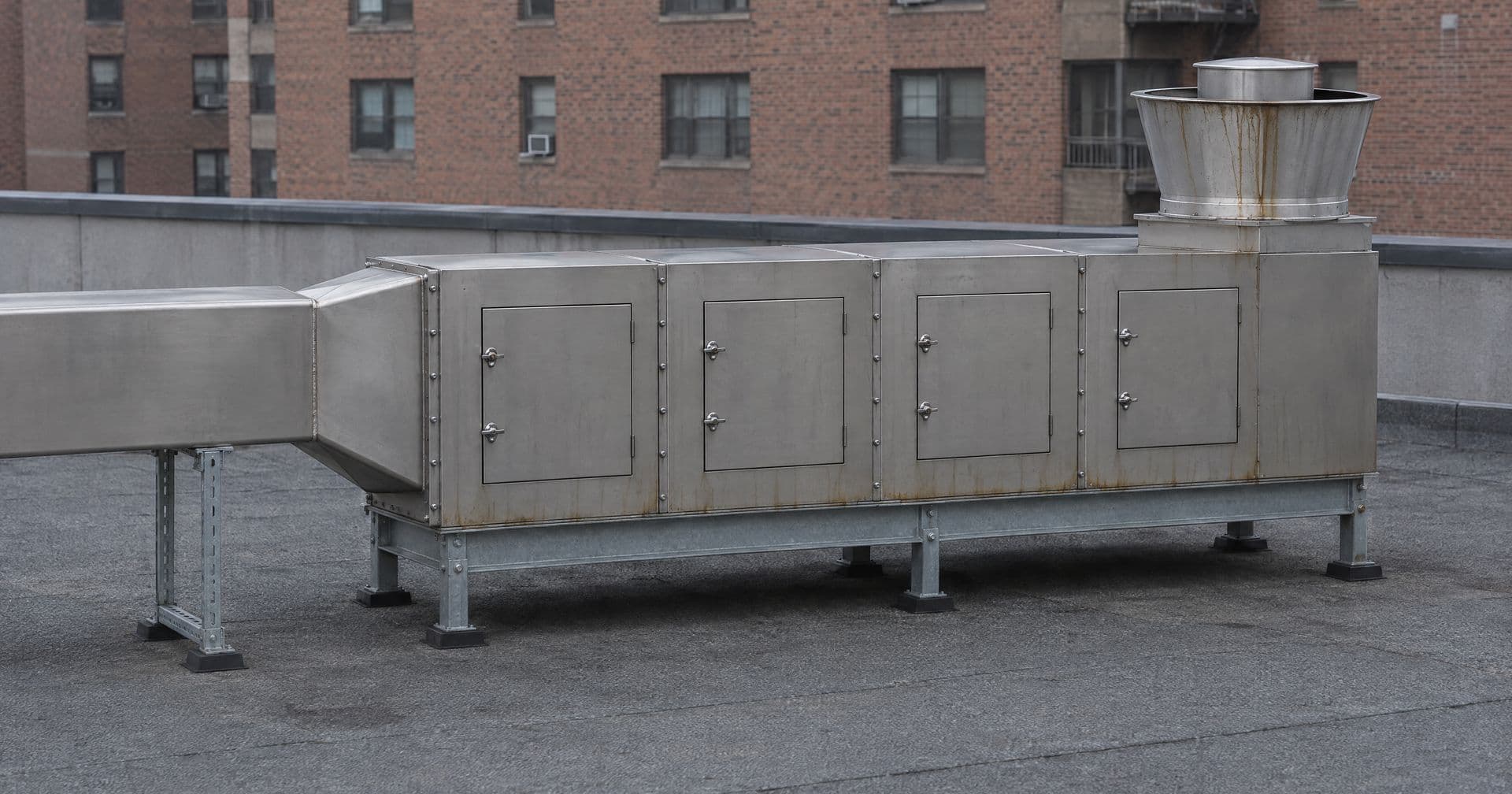
A pollution control unit — sometimes called a PCU, rooftop pollution unit, or exhaust emission system — sits in your kitchen exhaust pathway, typically on the roof or integrated into your ductwork. Its job is straightforward: capture grease particles, smoke, and odor-causing compounds before they leave your exhaust stack and drift into the surrounding environment.
Think of it as the last line of defense between your commercial kitchen and the outside world. Your hood captures the initial grease and smoke. Your ductwork channels it upward. But without a functioning PCU, everything your hood catches only partially gets filtered — and the rest goes straight out the top of your building, where wind patterns, building height, and sheer proximity to neighbors determine who gets to enjoy it.
Most commercial PCUs use one or more of three core technologies, often in combination:
1. Electrostatic Precipitators (ESPs)
An ESP is the workhorse of most pollution control systems. It uses electrically charged plates — called electrodes — to attract and capture grease particles and smoke as exhaust air passes through the unit. Think of it like a magnet for grease. The incoming air passes through ionizing wires that give particles an electrical charge, and then those charged particles stick to collector plates inside the unit.
When an ESP is clean and functioning properly, it can remove up to 95% of grease particles and visible smoke from your exhaust stream. That's remarkable efficiency. But here's the catch: as grease builds up on those collector plates and ionizing wires, efficiency drops fast. A heavily soiled ESP might only be capturing 30-40% of what it should — and the rest is going straight out your stack.
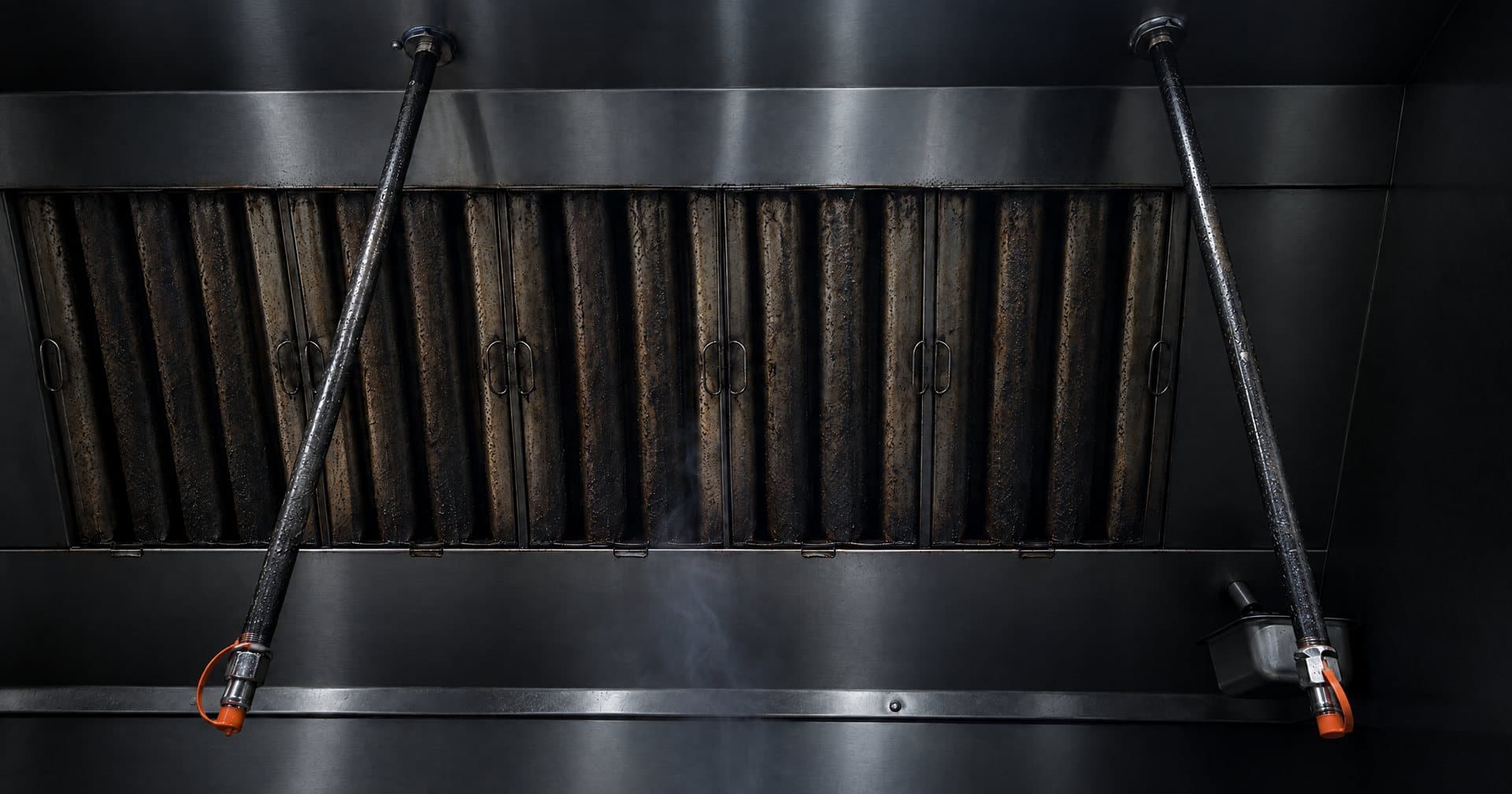
Even worse, grease-caked electrodes create a serious fire hazard. Grease is fuel. Electrical components generate heat. Put those together in an unmaintained unit on your roof, and you're looking at a potential grease fire that could cause tens of thousands of dollars in damage — or worse.
2. UV (Ultraviolet) Systems
UV systems use ultraviolet light to break down grease molecules and volatile organic compounds in the exhaust stream. Some units use UV-C light specifically to destroy odor-causing compounds at a molecular level. These systems are particularly effective at addressing the smell component that drives neighbor complaints.
The limitation? UV bulbs degrade over time. A bulb that's been running for 12-14 months is likely operating at a fraction of its original intensity, even if it still appears to be "on." This is one of the most common issues we see in the field — operators assume their UV system is working because the light is still glowing, but the bulb has long since dropped below effective output levels. Most manufacturers recommend replacing UV bulbs every 9-12 months, depending on usage and kitchen volume.
3. Carbon Filters
Activated carbon filters are the odor specialists. They work through a process called adsorption — odor molecules bind to the massive surface area of activated carbon granules as air passes through the filter. A single pound of activated carbon can have a surface area of over 100 acres at the microscopic level, which is why these filters are so effective at neutralizing the complex odor compounds that commercial cooking produces.
But carbon filters have a finite capacity. Once the available surface area is saturated with captured molecules, the filter stops working. It doesn't slow down gradually — it essentially hits a wall. For high-volume kitchens, especially those doing heavy frying, grilling, or charbroiling, carbon filters can reach saturation in as little as 4-8 weeks. Once saturated, exhaust passes through the filter essentially untreated.
Why Your PCU Matters More in the DMV Than Almost Anywhere Else
The Washington DC metropolitan area presents a unique combination of challenges for commercial kitchen operators when it comes to exhaust emissions. Here's why:
Building Density and Mixed-Use Development
The DMV has seen an explosion of mixed-use development over the past two decades. In Arlington, Fairfax, Montgomery County, Prince George's County, and throughout DC, restaurants are increasingly located in buildings that also house residential units, offices, medical practices, and retail spaces. The days of standalone restaurant buildings with nobody around to notice your exhaust are largely over.
When your restaurant is on the ground floor of a 12-story residential building in Bethesda, or sharing a strip mall with a pediatric dentist in Manassas, or operating in a row of mixed-use storefronts in the H Street corridor — your exhaust isn't disappearing into empty air. It's drifting into someone's living room, someone's office, someone's waiting area. And those people will complain.
Local Nuisance Regulations Are No Joke
Each jurisdiction in the DMV has its own approach to commercial kitchen emissions, and none of them are lenient:
- Washington, DC: The DC Department of Energy and Environment (DOEE) regulates air quality emissions and can issue fines for visible smoke emissions and odor nuisance violations. The DC Municipal Regulations address odor nuisance under environmental and public health codes, with fines that can start at $1,000 per violation per day. Repeat offenders face escalating penalties, and in severe cases, DOEE can pursue cease-and-desist orders that shut down your kitchen ventilation entirely.
- Virginia: Counties like Arlington, Fairfax, Loudoun, and Prince William enforce nuisance ordinances through their respective zoning and code enforcement departments. Arlington County, for example, has been particularly aggressive in recent years about commercial cooking odor complaints, especially in the Clarendon and Ballston corridors where mixed-use density is highest. Fines in Virginia jurisdictions typically range from $250 to $2,500 per violation, and repeated violations can trigger conditional use permit reviews — meaning your right to operate at that location comes into question.
- Maryland: Montgomery County and Prince George's County both have environmental nuisance codes that apply to commercial kitchen emissions. Montgomery County's Department of Environmental Protection has been known to require operators to install or upgrade pollution control equipment as a condition of resolving complaints. In Howard County and Anne Arundel County, similar enforcement mechanisms exist. Fines in Maryland jurisdictions can run $500 to $5,000 per incident, and county health departments can tie emissions violations to food service permit renewals.
HOAs, Landlords, and Lease Trouble
Beyond government enforcement, there's a whole layer of private consequences that often hits faster and harder. Commercial landlords in the DMV market are sophisticated, and most modern leases include specific provisions about exhaust systems, odor control, and nuisance complaints. We've seen lease agreements in Tysons Corner, Rockville, and downtown DC that require tenants to maintain PCU equipment on a documented schedule — and failure to comply constitutes a lease violation.
HOA boards in mixed-use buildings can be even more relentless. A residential HOA board that starts receiving complaints about cooking odors in the hallways or HVAC intakes will escalate quickly. They have legal counsel on retainer, and they know how to apply pressure. We've worked with restaurant operators in the Mosaic District, in downtown Silver Spring, and in Navy Yard who found themselves facing $200-per-day HOA fines on top of remediation requirements — all because their PCU maintenance had lapsed.
What Happens When You Neglect Your PCU
Let's be blunt about the cascade of consequences that follows PCU neglect, because we see this pattern play out repeatedly across the DMV:
- Efficiency drops quietly. Your ESP collector plates get coated in grease. Your UV bulbs degrade. Your carbon filters saturate. None of this triggers an alarm or a warning light. Your kitchen keeps running, and you have no idea your PCU is operating at 30% capacity.
- Smoke and odor increase gradually. Your staff doesn't notice because they're in it every day. But your neighbors notice. The complaints start — first informal, then formal.
- Code enforcement gets involved. A complaint triggers an inspection. The inspector finds your PCU isn't maintained, your maintenance logs are nonexistent, and your exhaust is visibly problematic. You receive a notice of violation with a compliance deadline.
- Remediation costs spike. A PCU that's been neglected for 6-12 months doesn't just need a cleaning — it may need component replacement. Warped or corroded ESP cells can cost $3,000 to $8,000 per cell to replace. A full set of replacement carbon filters for a commercial unit runs $1,500 to $4,000. UV bulb replacement sets typically cost $500 to $1,500. And if the unit itself is damaged beyond repair, a new commercial PCU installation runs $15,000 to $45,000 depending on the system type and kitchen volume.
- Your lease or permits are in jeopardy. Sustained violations can trigger lease termination proceedings, conditional use permit reviews, or health department holds on your food service license. At this point, the cost of fixing the PCU is the least of your problems.
Compare all of that to the cost of regular maintenance: $300 to $800 per service visit, performed every 1-3 months depending on your kitchen's cooking volume and type. The math isn't complicated.
What Proper PCU Maintenance Actually Involves
There's a reason PCU maintenance isn't a DIY job. These are specialized systems with electrical components, and they require trained technicians who understand both the equipment and the regulatory requirements. Here's what a proper maintenance visit includes:
ESP Cleaning
The collector plates and ionizing wires need to be thoroughly degreased and cleaned. This involves removing the cells from the unit, soaking or pressure-washing them with appropriate degreasers, inspecting for damage or warping, and reinstalling them with proper alignment. Misaligned cells don't just reduce efficiency — they can cause electrical arcing, which is both a fire hazard and an equipment damage risk. A qualified technician will also check the power supply unit, test voltage output, and verify that the system is ionizing properly.
UV Bulb Assessment and Replacement
UV bulbs need to be checked for output intensity, not just whether they're still illuminating. A technician with a UV intensity meter can determine whether bulbs are still producing effective output or whether they've degraded past their useful life. Bulbs that are cracked, discolored, or coated in grease residue need immediate replacement. Proper UV maintenance also includes cleaning the quartz sleeves that protect the bulbs, since grease buildup on these sleeves blocks UV output even when the bulbs themselves are still functional.
Carbon Filter Service
Depending on the filter type, carbon filters are either cleaned and recharged or replaced entirely. Some commercial systems use refillable carbon cells where the activated carbon media can be replaced while reusing the filter housing. Others use sealed disposable cartridges. A technician will assess filter condition, check for channeling (where air finds paths through depleted sections of carbon rather than passing through active media), and either service or replace filters as needed.
Electrode Cleaning and Inspection
The ionizing electrodes in an ESP system are precision components. They need to be cleaned of all grease and carbon buildup, inspected for physical damage or corrosion, and tested for proper electrical function. Damaged electrodes reduce ionization efficiency and can cause the entire ESP system to underperform even when the collector plates are clean.
System Testing and Documentation
After all components are serviced, the entire system needs to be tested as a unit. A qualified technician will verify airflow rates, check for proper electrical function across all components, test for visible smoke and odor at the exhaust outlet, and document everything. That documentation matters — when a code enforcement officer asks to see your maintenance records, a folder of dated service reports from a licensed commercial kitchen maintenance company is your best defense.
How Often Should Your PCU Be Serviced?
The honest answer is: it depends on your operation. But here are general guidelines based on what we see across hundreds of commercial kitchens in the DMV:
- Heavy charbroiling, wood-fired cooking, or high-volume frying: Every 4-6 weeks. These cooking methods produce the highest concentrations of grease particles and smoke, and they'll saturate your PCU components faster than anything else.
- Standard full-service restaurant with mixed cooking methods: Every 6-8 weeks. This covers the majority of sit-down restaurants running a typical line with a combination of sauteing, grilling, frying, and oven work.
- Light cooking operations (cafes, bakeries, prep kitchens): Every 8-12 weeks. Lower grease output means slower buildup, but don't let the longer interval fool you into skipping services. Even light-cooking operations generate enough particulate to degrade ESP and filter performance over a quarter.
Your PCU manufacturer's recommendations should also factor into your schedule, and a good service provider will help you dial in the right frequency based on your specific equipment, menu, and operating hours.
Choosing a PCU Maintenance Provider
Not every hood cleaning company is equipped to service pollution control units. PCUs involve electrical systems, specialized components, and manufacturer-specific procedures that go well beyond standard hood and duct cleaning. When evaluating a PCU service provider, look for the following:
- Experience with your specific PCU type. There are several major PCU manufacturers — Captive-Aire, Accurex, Streivor, Ecology, and others — and each has different designs and service requirements. Your provider should have hands-on experience with your specific unit.
- Proper documentation practices. Every service visit should produce a detailed report with before-and-after photos, component condition notes, and recommendations for upcoming maintenance or repairs. These records are your proof of compliance.
- Knowledge of local regulations. A provider serving the DMV market should understand the specific requirements and enforcement patterns in DC, Virginia, and Maryland jurisdictions. Generic national providers often lack this local knowledge.
- Ability to service all PCU components. Some providers only clean ESP cells and skip UV systems or carbon filters. You need a provider who addresses the complete system — ESP, UV, carbon, electrodes, power supply, and airflow.
The Bottom Line: Your PCU Is Not Optional Equipment
We understand that PCU maintenance doesn't feel urgent when you're managing labor costs, food costs, equipment breakdowns, and a hundred other daily challenges. It's the kind of thing that's easy to push to next month, and then the month after that. But we've seen what happens when it gets pushed too far — and the cost of remediation, fines, lease disputes, and reputation damage always exceeds the cost of consistent, scheduled maintenance.
Your pollution control unit exists for a reason. It protects your neighbors, keeps you in compliance with local regulations, prevents fire hazards from grease accumulation, and ultimately protects your right to operate your business at your current location. When it's working properly, nobody thinks about it — which is exactly how it should be.
When it's not working properly, everybody thinks about it. Your neighbors, your landlord, the HOA board, the county code enforcement office, and eventually your insurance company. That's not a situation any restaurant operator wants to be in.
Get Your PCU Assessed — On Us
Qwick Services and Solutions provides comprehensive pollution control unit maintenance for commercial kitchens across Virginia, Washington DC, and Maryland. We service all major PCU types and manufacturers, including ESP cleaning, electrode maintenance, UV bulb replacement, and carbon filter cleaning and replacement.
We're offering free PCU assessments for commercial kitchen operators in the DMV area. Our technicians will inspect your unit, evaluate its current operating condition, identify any immediate concerns, and provide you with a clear maintenance recommendation — no obligation, no pressure.
Whether you're dealing with active complaints and need immediate remediation, or you simply want to get ahead of potential problems before they become expensive ones, we're here to help. We understand the local regulations, we know the equipment, and we've been solving these problems for commercial kitchens throughout the region.
Contact Qwick Services and Solutions today to schedule your free PCU assessment. Don't wait for the letter from your landlord or the knock from code enforcement. Let's make sure your pollution control unit is doing exactly what it's supposed to do — so you can focus on running your restaurant.