You've Tried Everything. New Wages. Signing Bonuses. Free Meals. They Still Leave.
You posted on Indeed, Poached, and every restaurant job board you could find. You bumped your line cook pay from $17 to $21 an hour. You started offering a $500 signing bonus and free shift meals. You even let your sous chef build the schedule around everyone's availability.
And they still quit. Not after a blowup. Not after a bad night. They just stop showing up one Tuesday, and three days later you see them working at the new place that opened on King Street, or that brunch spot in Clarendon, or the hotel kitchen in Tysons that somehow has air conditioning that actually works.
You tell yourself it's the industry. Turnover is just part of the business. The National Restaurant Association says the average turnover rate in food service exceeds 70% annually. In fast-paced, high-volume kitchens across the DMV, it can hit 100% or higher. So maybe this is just normal.
It is not normal. And it does not have to be your normal.
After a decade of servicing commercial kitchens across Virginia, DC, and Maryland, we have seen a clear pattern. The restaurants that cannot keep staff share one thing in common, and it is not their pay scale. It is their kitchen environment. Specifically, it is the heat, the air quality, the ventilation, and the mechanical systems that control all three.
The Kitchen Environment Problem Nobody Talks About in Interviews
When a line cook interviews at your restaurant, they ask about pay, hours, menu style, and maybe the chef's reputation. They do not ask what temperature the kitchen hits during Friday dinner service. They do not ask when the rooftop HVAC units were last serviced. They do not ask whether the makeup air system is properly balanced.
They find out all of that in their first week. And that is when the clock starts ticking.
Here is what your kitchen staff experiences that you might not fully appreciate, because you spend most of your time in the dining room, the office, or on the phone with vendors:
- Ambient kitchen temperature during peak service: 95 to 105 degrees. Standing within arm's reach of a flattop, a charbroiler, or a bank of fryers adds another 10 to 15 degrees to what they physically feel. When the makeup air system is not replacing exhausted air properly, there is no relief. The heat accumulates. By the third hour of service, the kitchen is functionally a sauna with knives.
- Grease-laden air that the hood is not fully capturing. When exhaust and makeup air systems are out of balance, the hood's capture efficiency drops. Smoke, steam, and aerosolized grease spill out from under the hood canopy. Your cooks are breathing this for eight to twelve hours a day, five to six days a week. Headaches, eye irritation, and respiratory discomfort are not weakness. They are symptoms of a mechanical failure.
- Inconsistent airflow that makes the space feel chaotic. Negative pressure from an underperforming makeup air unit creates drafts, door slamming, and unpredictable air movement. Papers fly off the pass. Tickets blow off the rail. The back door gets wedged open because it is the only source of relief, which introduces unfiltered outside air, insects, and security concerns.
Experienced cooks know the difference. They have worked in kitchens where the ventilation was right, where the temperature stayed under 88 degrees even during a 300-cover Saturday night. When they walk into your kitchen and realize your system is broken, they do not file a complaint. They update their resume.
The Real Math: What Turnover Actually Costs You
Most restaurant owners think of turnover as an inconvenience. Someone leaves, you hire someone new, life goes on. But the actual financial impact is staggering when you break it down.
Direct Costs Per Departure
- Recruiting and advertising: $200 to $600 per position, depending on market and platform
- Management time spent interviewing: 4 to 8 hours of your time or your chef's time, valued at $35 to $75 per hour
- Training period: 2 to 4 weeks at reduced productivity, effectively paying full wages for 60% to 70% output
- Overtime for existing staff covering shifts: Time-and-a-half for every shift the departing cook leaves uncovered, typically 2 to 3 weeks of gaps
- Mistakes and waste during the learning curve: New hires unfamiliar with your menu, your plating, and your systems generate more food waste and more comps
Conservative estimate per line cook departure in the DMV market: $3,500 to $6,000.
If you lose three cooks between May and September, a common pattern in kitchens with poor ventilation, you are spending $10,500 to $18,000 on turnover alone during your busiest and most profitable season.
Indirect Costs That Compound
- Service quality degrades. New cooks are slower. Ticket times increase. Plates go out inconsistently. Regulars notice.
- Morale drops. Your remaining staff absorbs extra work every time someone leaves. They start wondering if they should leave too. Turnover is contagious.
- Online reviews suffer. Longer wait times, inconsistent food, and stressed-out servers translate directly to 3-star reviews mentioning "slow service" and "food wasn't as good as last time." In a market as competitive as Northern Virginia or DC, those reviews cost you covers.
- Management burnout. You or your chef spend 30% of your time on hiring instead of running the business. That is time not spent on menu development, vendor negotiations, marketing, or the hundred other things that grow revenue.
The Connection Between Kitchen Conditions and Retention
Let us be direct about the cause and effect here. We are not speculating. We see this play out across dozens of restaurant clients every year.
When we perform a comprehensive HVAC and makeup air service on a restaurant that has been neglecting its systems, the owner almost always reports the same thing within 60 to 90 days: their kitchen staff stopped leaving.
Not because we did anything magical. Because the kitchen went from 98 degrees to 85 degrees. Because the hood started capturing properly and the air cleared up. Because the back door stayed closed because it no longer needed to be propped open. Because the staff could work a double on Saturday without feeling physically ill by the end of it.
This is not a theory. This is thermodynamics and human physiology.
OSHA guidelines recommend that heavy labor environments maintain temperatures below 77 degrees Fahrenheit. Realistically, a commercial kitchen during service will exceed that. But there is a massive difference between 85 degrees, which is manageable, and 100 degrees, which is dangerous.
At sustained temperatures above 95 degrees:
- Cognitive function decreases by 15% to 25%. Your cooks are more likely to make mistakes, misread tickets, and miss quality checks.
- Physical endurance drops significantly. Tasks that are routine at 85 degrees become exhausting at 100 degrees.
- Risk of heat-related illness increases. Heat exhaustion is not rare in DMV restaurant kitchens during summer. It is underreported because cooks push through it until they can not.
- Dehydration accelerates, even with water available. A cook losing two to three percent of body weight in fluid during a shift experiences measurable impairment.
Your cooks are not weak. They are working in conditions that would trigger a work stoppage on a construction site. The difference is that construction has OSHA enforcement and mandatory water breaks. Your kitchen does not.
What Actually Fixes This
The solution is not a bigger fan from Home Depot wedged in the back doorway. It is not a portable AC unit from Amazon sitting in the prep area. Those are band-aids that create new problems, disrupting airflow patterns, introducing contaminants, and masking the real issue.
The solution is getting your rooftop mechanical systems properly maintained and balanced. Specifically:
1. Exhaust and Makeup Air Balancing
Your exhaust hood removes a specific volume of air, measured in cubic feet per minute (CFM). Your makeup air unit must supply a matching volume. When these are out of balance, everything breaks down. Balancing these systems is a technical process that requires measurement, adjustment, and verification. It is the single most impactful thing you can do for kitchen temperature and air quality.
2. Quarterly HVAC Maintenance
Filters clog. Coils get dirty. Belts wear. Refrigerant leaks. Every one of these issues reduces your system's capacity incrementally. A system that was adequate when it was installed can lose 30% to 40% of its effective cooling capacity through deferred maintenance alone. Quarterly service keeps your equipment running at its designed capacity.
3. Makeup Air Unit Service
This is the unit that most general HVAC companies ignore because they do not understand commercial kitchen ventilation. If your makeup air unit has not been serviced in over a year, it is almost certainly underperforming. Clogged filters, worn belts, and failed heating or cooling elements mean the air entering your kitchen is unfiltered, unconditioned, and insufficient.
4. Kitchen Airflow Assessment
Sometimes the equipment is adequate but the distribution is wrong. Supply air diffusers pointed in the wrong direction, blocked return vents, or ductwork modifications made during a previous tenant's buildout can all disrupt airflow patterns. A comprehensive assessment identifies these issues and provides specific solutions.
A Real Scenario From a Fairfax County Restaurant
A 4,200-square-foot restaurant in Fairfax County called us in August after losing their fourth line cook in three months. The owner had raised wages twice and was offering a $750 signing bonus. Nothing was working.
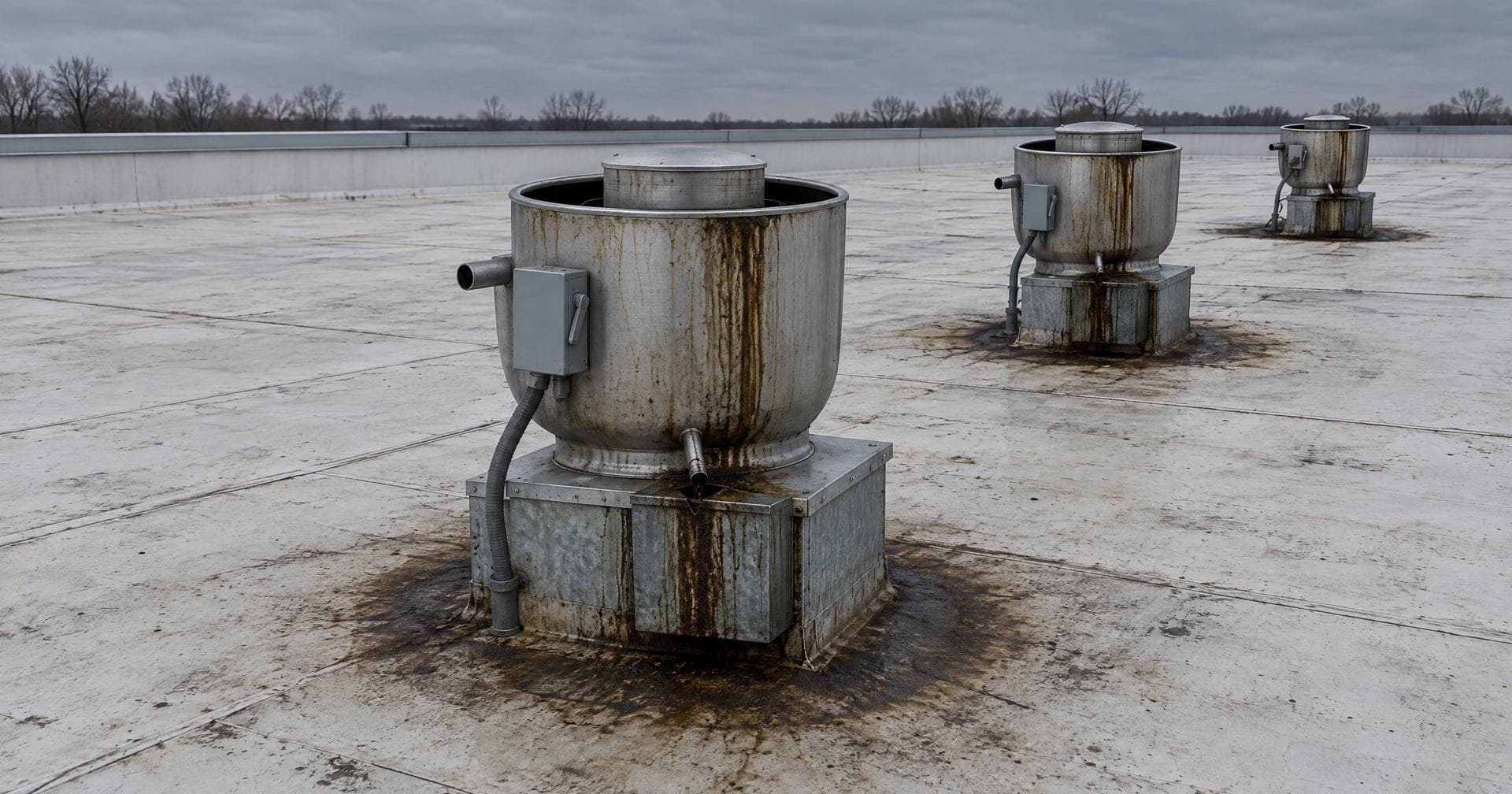
When our technicians got on the roof, we found:
- The makeup air unit had not been serviced in over two years. All four filters were completely clogged. One belt had snapped and was sitting in the bottom of the unit.
- The RTU's condenser coils were so coated with grease and debris that cooling capacity was reduced by an estimated 35%.
- The exhaust system was pulling 4,200 CFM while the makeup air unit, in its degraded state, was supplying roughly 2,100 CFM. The kitchen was under severe negative pressure.
We replaced filters, installed new belts, cleaned all coils, recharged refrigerant, and balanced the airflow. Total cost of the service visit: $1,850.
The owner called us two weeks later. Kitchen temperature during Saturday dinner service had dropped from 101 degrees to 86 degrees. The back door stayed closed for the first time in two summers. Two of the cooks who had been talking about leaving told the chef they noticed the difference.
That $1,850 service call saved the owner an estimated $12,000 to $18,000 in turnover costs over the following six months. And it made the kitchen a place where professionals could actually do their jobs.
The Competitive Advantage Nobody Is Talking About
In a market where every restaurant in Arlington, Alexandria, Bethesda, and the District is competing for the same pool of experienced kitchen staff, your kitchen environment is a differentiator. Not on the job posting. Not in the interview. But in the first week, and every week after that.
The restaurants that retain staff are not always the ones paying the most. They are the ones where the kitchen is runnable. Where the ventilation works. Where the temperature is manageable. Where the air is clean enough that your cooks do not go home with headaches every night.
You cannot fix the restaurant industry's labor shortage. But you can fix your kitchen. And the fix starts on the roof, with equipment you might not even know you have, doing a job you might not have realized was failing.
Stop Losing Good People to a Maintenance Problem
Qwick Services and Solutions provides comprehensive HVAC, makeup air, and kitchen ventilation services for commercial kitchens across Virginia, Washington DC, and Maryland. We specialize exclusively in restaurant and commercial kitchen environments because the mechanical demands are fundamentally different from office buildings, retail spaces, and residential properties.
If your kitchen is too hot, if your staff keeps leaving, and if you have tried everything except fixing the air system that controls your entire kitchen environment, it is time for a different approach.
Our free kitchen environment assessment includes rooftop equipment inspection, airflow measurement, temperature mapping, and a written report with specific recommendations and transparent pricing. We serve restaurants throughout Northern Virginia, DC, and Maryland, including Fairfax, Arlington, Alexandria, Loudoun, Prince William, Montgomery County, Prince George's County, and the entire DMV region.
Your best cooks are not leaving because of the money. They are leaving because of the heat. Let us fix that.