It's a Tuesday Lunch Rush -- and Your Kitchen Just Flooded
Picture this: it's 11:45 a.m. on a Tuesday. Your dining room is filling up, tickets are printing, and your line cooks are in full swing. Then somebody calls out from the dish pit. There's murky, foul-smelling water pooling on the floor near the three-compartment sink. Within minutes, it's creeping toward the cooking line. Greasy, brownish sludge is backing up through the floor drain. The smell hits the dining room. Customers notice.
Your grease trap just overflowed.
If you've been in the restaurant business long enough, you know this isn't some hypothetical nightmare -- it happens to kitchens across Virginia, Maryland, and Washington, D.C. every single week. And the consequences go far beyond mopping up a mess. We're talking health department shutdowns, environmental fines that can reach five figures, emergency plumbing bills, and the kind of reputation damage that doesn't wash off easily.
Let's break down exactly what happens when a grease trap overflows, why it happens, what it costs, and -- most importantly -- how to make sure it never happens to you.
What Actually Is a Grease Trap (And Why Does It Overflow)?
A grease trap -- sometimes called a grease interceptor -- is a plumbing device that captures fats, oils, and grease (FOG) before they enter the municipal sewer system. Every commercial kitchen that produces FOG is required to have one. It works on a simple principle: grease floats. Wastewater enters the trap, grease rises and gets retained, and relatively clean water exits through the outlet to the sewer line.
The problem? Grease traps have a finite capacity. And when the accumulated FOG exceeds roughly 25% of the trap's total capacity -- known in the industry as the "25% rule" -- the trap stops working effectively. Grease starts passing through into the sewer line, solidifying as it cools and gradually building a blockage. Eventually, wastewater has nowhere to go but back up through your drains and onto your kitchen floor.
Common Causes of Grease Trap Overflows
- Irregular or skipped pump-outs: The number one cause. If your trap isn't being pumped on a schedule that matches your kitchen's output, overflow is a matter of when, not if.
- High-volume periods without adjusted service: Catering seasons, holiday rushes, and special events dramatically increase FOG output. Your normal 90-day pump schedule might need to drop to every 30 days during peak periods.
- Improper scraping and pre-cleaning practices: Kitchen staff dumping food waste and oils directly into sinks rather than scraping plates into waste bins.
- Wrong trap size for the operation: A 20-gallon trap installed for a quick-service spot doesn't cut it when the space gets converted to a full-service restaurant doing 300 covers a night.
- Lack of drain line maintenance: Even with regular pump-outs, grease buildup in the connecting drain lines can cause backups. Periodic jetting of those lines is essential.
The Mess: What an Overflow Looks Like in Real Life
Let's not sugarcoat it. A grease trap overflow is one of the most disruptive events a commercial kitchen can experience. Here's what actually happens:
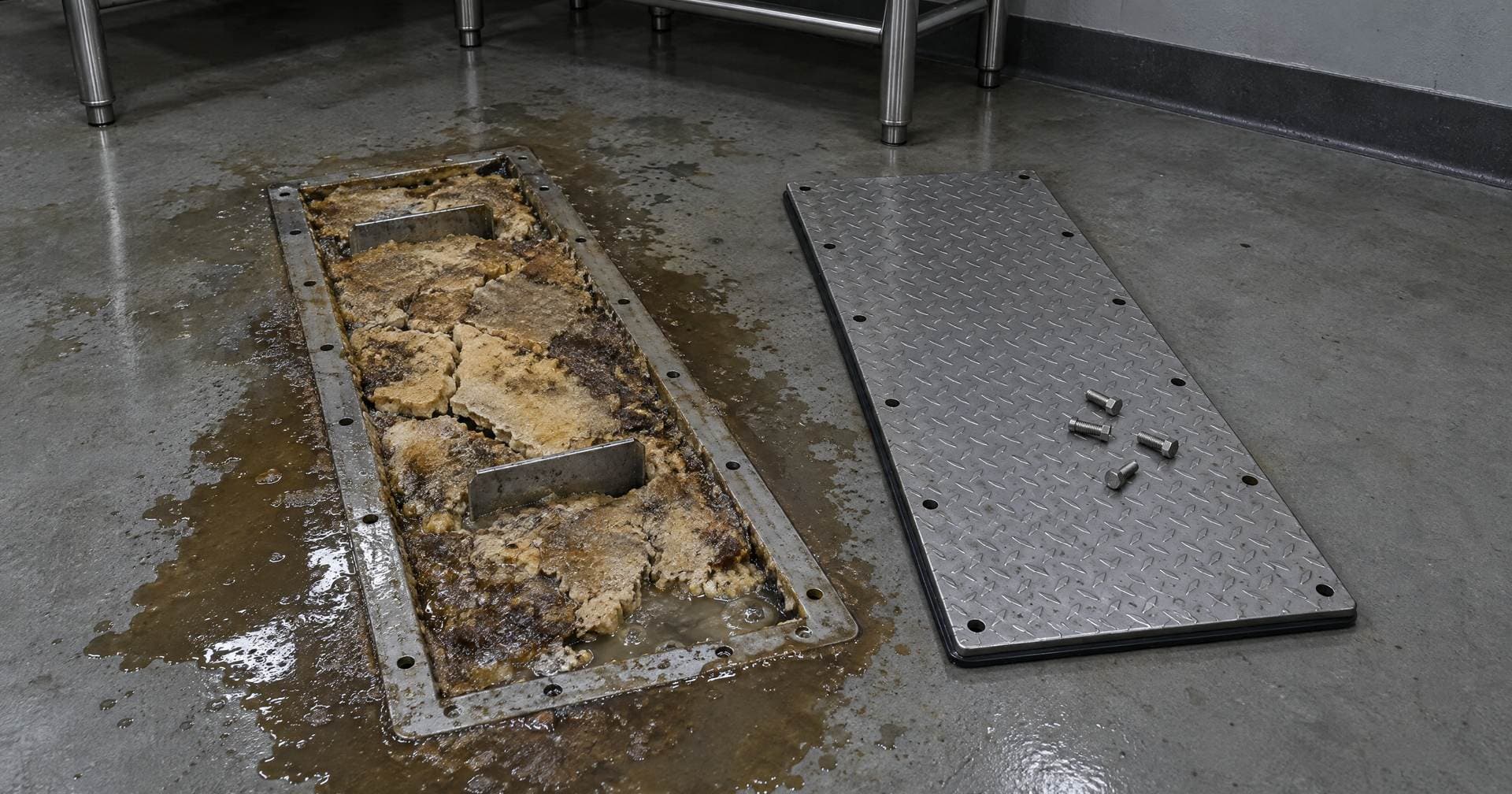
Wastewater backs up through floor drains, sink drains, or both. This water contains accumulated fats, oils, grease, food particles, and bacteria. It's dark, it's viscous, and it smells terrible -- a combination of rancid grease and sewage that can clear a room in seconds.
The contamination spreads fast. Commercial kitchen floors are designed for drainage, which means they're often slightly sloped. That same slope sends overflow water flowing across the kitchen, potentially reaching food prep areas, dry storage, walk-in coolers, and dining room floors.
Operations stop. You can't serve food in a kitchen contaminated by sewage backflow. Depending on the severity, you're looking at a partial or full shutdown until the mess is cleaned, the cause is resolved, and -- in many jurisdictions -- a health inspector signs off on reopening.
The Cleanup Costs Add Up Fast
Emergency grease trap service during an active overflow typically runs $800 to $2,500, depending on the size of the trap, time of day, and severity of the backup. But that's just the starting point:
- Professional sanitization and decontamination: $500 - $3,000, depending on the area affected
- Emergency plumber for drain line clearing: $300 - $1,200
- Lost revenue from closure: The average full-service restaurant in the DMV area generates $2,500 - $8,000+ per day in revenue. Even a half-day shutdown hurts.
- Food spoilage and disposal: If contaminated water reaches food storage areas, health codes require disposal of all compromised product. That can easily be $1,000 - $5,000 in lost inventory.
- Staff costs: Your team is still on the clock during cleanup, and you may need to pay overtime to get back on track.
All told, a single grease trap overflow can cost a restaurant $5,000 to $15,000 or more when you add up the direct costs and lost business. Compare that to routine pump-outs that typically run $250 to $600 per service.
The Fine: Regulatory Consequences Across the DMV
The mess is bad enough. But the regulatory fallout can be even worse. Jurisdictions across Virginia, Maryland, and Washington, D.C. take FOG management seriously, and violations can result in significant penalties.
Fairfax County, Virginia
Fairfax County's Wastewater Management Program requires all food service establishments to maintain grease interceptors and keep documentation of maintenance. FOG discharge violations can result in fines starting at $1,000 per day per violation. Repeated non-compliance can trigger a Notice of Violation (NOV) that goes on your establishment's public record and may result in mandatory increased inspection frequency. The county requires maintenance records to be kept on-site and available for inspection at all times.
Arlington County, Virginia
Arlington's FOG program requires regular maintenance with documentation. Violations of the county's sewer use ordinance can result in fines of up to $2,500 per violation per day, and the county can require corrective action plans, facility modifications, or even revoke sewer discharge permits for chronic offenders.
Montgomery County, Maryland
Montgomery County operates under strict WSSC Water regulations. Grease interceptors must be pumped and cleaned before reaching 25% capacity. Fines for FOG violations can range from $1,000 to $25,000, and WSSC reserves the right to install monitoring equipment at the establishment's expense. They've been known to mandate pump-out frequencies as often as every two weeks for chronic violators.
Prince George's County, Maryland
Similar to Montgomery County, Prince George's County enforces WSSC Water's FOG regulations. Non-compliant facilities face fines, mandatory grease interceptor upgrades, and potential sewer service disconnection for repeated violations. Given that PG County has seen significant sewer infrastructure investment in recent years, enforcement has been intensifying.
Washington, D.C.
DC Water's FOG program is one of the most aggressive in the region. Commercial kitchens must maintain grease interceptors in proper working condition and keep records of all cleaning and maintenance. Violations can result in fines of $2,500 to $10,000 per occurrence. DC Water conducts unannounced inspections and has the authority to issue immediate compliance orders. In severe cases, they can terminate sewer service -- which effectively shuts down your restaurant until the issue is resolved.
The Environmental Angle
Beyond local FOG programs, grease trap overflows that reach storm drains or waterways can trigger federal Clean Water Act violations and state environmental enforcement actions. If an overflow from your establishment contaminates a waterway -- even indirectly through the storm sewer system -- you could be facing environmental remediation costs and penalties that dwarf the local FOG fines. The Chesapeake Bay watershed, which covers the entire DMV region, is subject to enhanced environmental protections that make authorities particularly aggressive about sewer contamination sources.
The Health Department Factor
Separate from the sewer authority fines, a grease trap overflow can trigger action from your local health department. A sewage backup in a food preparation area is a critical health code violation in every jurisdiction across the DMV.
Here's what that means in practice:
- Immediate closure order: Health inspectors can and will shut you down on the spot if they observe or learn of a sewage backup in your kitchen.
- Reinspection required before reopening: You don't just clean up and reopen. An inspector has to come back, verify the source has been corrected, confirm proper sanitization, and sign off before you serve another plate.
- Public record: Health inspection results are public. In many DMV jurisdictions, they're posted online. A critical violation related to sewage stays on your record and is visible to every potential customer who checks your inspection scores.
- Impact on permits and renewals: Repeated critical violations can complicate your annual health permit renewal and may trigger increased inspection frequency at your expense.
The Fix: A Maintenance Program That Actually Works
Here's the good news: grease trap overflows are almost entirely preventable. They don't happen out of nowhere -- they happen because maintenance was deferred, skipped, or inadequate. A proper grease trap maintenance program eliminates the risk.
Follow the 25% Rule -- No Exceptions
The industry standard is clear: your grease trap should be serviced before accumulated FOG reaches 25% of the trap's total capacity. For most commercial kitchens, this means scheduling pump-outs every 30 to 90 days, depending on your volume, menu type, and trap size.
How do you know where you fall on that spectrum?
- High-volume restaurants, fried food concepts, and busy catering operations: Every 30 days, sometimes more frequently.
- Moderate-volume full-service restaurants: Every 45-60 days.
- Lower-volume cafes, delis, and light-prep kitchens: Every 60-90 days.
A professional grease trap service provider will assess your specific operation and recommend the right frequency. If they're not doing that -- if they're just putting you on a generic quarterly schedule without evaluating your actual FOG production -- find a better provider.
Include Drain Line Jetting
Pumping the trap is only half the equation. The drain lines connecting your sinks, floor drains, and dishwashers to the grease trap accumulate grease buildup over time, even with regular pump-outs. Periodic hydro-jetting of these lines -- typically every 3 to 6 months -- prevents the gradual narrowing that leads to slow drains and eventually full blockages.
Think of it this way: pumping the trap empties the bucket, but jetting the lines clears the pipes that lead to the bucket. You need both.
Demand Proper Documentation
Every jurisdiction in the DMV requires you to maintain records of grease trap service. Your provider should furnish you with:
- Service manifests documenting the date, volume pumped, and condition of the trap
- Waste disposal documentation showing proper handling of the grease waste at a licensed disposal facility
- Condition reports noting any issues with the trap's baffles, inlet/outlet tees, or structural integrity
Keep these records organized and accessible. When the inspector asks -- and they will ask -- you want to hand them a complete file, not scramble to call your service company for copies.
Train Your Kitchen Staff
Even the best maintenance program can't compensate for consistently poor kitchen practices. Make sure your team understands:
- Scrape before rinsing: All plates, pans, and cookware should be scraped into waste bins before going to the dish pit.
- Never pour oil down drains: Used cooking oil goes in designated containers for pickup, not down the sink.
- Wipe greasy equipment before washing: A quick wipe with a paper towel or disposable rag before washing removes a significant amount of FOG that would otherwise enter the trap.
- Report slow drains immediately: A slow drain is an early warning sign. If staff report it promptly, you can address the issue before it becomes an overflow.
Get Your Trap Sized Correctly
If you're experiencing frequent overflows despite regular maintenance, your trap may be undersized for your operation. This is especially common in the DMV's restaurant scene, where spaces frequently change concepts -- a location that was a sandwich shop with a 40-gallon trap might now be a high-volume Asian fusion restaurant doing heavy wok cooking. The old trap simply can't keep up.
A professional assessment can determine the correct trap size based on your fixture count, flow rates, and menu type. Upgrading your trap is a one-time investment that pays for itself many times over in avoided emergencies and fines.
Warning Signs You Shouldn't Ignore
Grease trap overflows don't happen without warning. If you're paying attention, the signs are clear weeks before the crisis:
- Slow-draining sinks or floor drains: The most obvious early warning. If water is pooling rather than draining promptly, FOG buildup is restricting flow somewhere in the system.
- Foul odors near sinks, drains, or the trap itself: Grease traps don't smell great, but a noticeably worsening odor indicates the trap is nearing capacity or food waste is decomposing inside.
- Grease visible in the trap's inspection port: If you open the lid and see grease at or near the top, you're overdue for service.
- Gurgling sounds from drains: Air trapped by grease blockages creates distinctive gurgling. This means flow is significantly restricted.
- Grease appearing in unexpected places: If you're seeing grease around the base of the trap, on the floor near drain connections, or backing up into sinks you don't expect, the system is telling you something is wrong.
Any one of these signs should trigger an immediate call to your grease trap service provider. Don't wait for the scheduled service date -- by then, you might be dealing with a full overflow.
The Math Is Simple
Let's put it in perspective with straightforward numbers:
- Routine grease trap pump-out: $250 - $600 per service, every 30-90 days
- Annual cost of proper maintenance: $1,500 - $4,800 per year (including drain line jetting)
- Cost of a single overflow event: $5,000 - $15,000+ in cleanup, lost revenue, and emergency service
- Cost of regulatory fines: $1,000 - $25,000 per violation, depending on jurisdiction
- Cost of health department closure: Incalculable when you factor in reputation damage and lost customer trust
Spending $3,000 a year on maintenance to avoid a single event that could cost you $20,000 or more -- plus your reputation -- isn't a tough decision. It's just good business.
Don't Wait for the Overflow. Get Ahead of It.
If you're reading this article and realizing your grease trap maintenance has been inconsistent, reactive, or nonexistent -- you're not alone. A surprising number of restaurant operators across the DMV are running on borrowed time with their grease management. The good news is that getting on track is straightforward, and it starts with a single conversation.
Qwick Services and Solutions provides professional grease trap pumping and maintenance for commercial kitchens throughout Virginia, Washington, D.C., and Maryland. Our service includes:
- Comprehensive grease trap pump-outs on a schedule tailored to your specific operation and FOG output
- Drain line hydro-jetting to prevent buildup in connecting pipes
- Proper grease waste disposal with full manifests and documentation for your compliance records
- Trap condition assessment with every service visit, so you know about potential issues before they become emergencies
- Free initial assessments to evaluate your current setup, determine the right service frequency, and identify any immediate concerns
Our technicians are NFPA-96 certified and experienced with the specific regulatory requirements across every DMV jurisdiction -- from Fairfax County and Arlington to Montgomery County, Prince George's County, and the District. We don't just pump your trap; we help you build a maintenance program that keeps you compliant, operational, and out of trouble.
Contact Qwick Services and Solutions today for a free grease trap assessment. Call us at (202) 643-8113 or request a quote online. We'll evaluate your system, recommend the right service plan, and make sure the next overflow story you hear is somebody else's -- not yours.